How to Run a Telecom RFP in Minutes, Not Months
Run a telecommunications RFP with Lightyear’s free online questionnaire. Define needs, compare bids, and track projects to cut delays and costs.


Most telecom RFPs drag on for months, drain valuable staff hours, and still produce overpriced, outdated contracts. It doesn’t have to be that way. Here’s how forward-looking enterprises are running faster, smarter RFPs, and getting better results.
What is a telecom RFP?
A telecom RFP (Request for Proposal) is a formal document used by enterprises to solicit competitive bids from service providers for telecommunications services. It’s closely related to other procurement tools like RFQs (Requests for Quotation) and RFIs (Requests for Information), which organizations sometimes use earlier in the process to gather details or narrow vendor options.
It defines the scope of work, technical requirements (bandwidth, service types, SLAs), and pricing expectations for services like internet connectivity, WAN solutions, voice systems, and colocation.
The goal is to compare proposals side-by-side and select the provider that best meets your business needs while balancing cost, service quality, and contract terms.
For most organizations, RFPs represent the primary method for sourcing telecom services at scale. They create a structured evaluation process that helps IT teams justify vendor selections to finance and executive leadership.
How telecom RFPs get run today
Most telecom RFPs today still follow a manual, fragmented process that looks something like this:
- Someone builds the RFP in Word or Excel
Usually, this starts by copying an old document and tweaking the service details.
Technical requirements, bandwidth needs, and SLAs are updated manually, leaving plenty of room for outdated or inconsistent information.
- The RFP is sent to a vendor list or broker
Distribution happens via email attachments or through a broker’s personal contacts. There’s no central portal for solicitations, so visibility into who received the RFP—or when—is limited.
- Vendors reply in a mix of formats
Some proposals arrive as PDFs, others as spreadsheets, and a few as long email responses. Critical details may be buried in attachments or missing entirely, making it hard to compare offers directly.
- Teams attempt to compare bids in spreadsheets
If comparisons happen at all, they’re likely done manually in Excel. Without a standardized scoring model, evaluation becomes subjective. One department focuses on price, another on performance.
- Any RFP changes are sent as follow-up emails
When requirements shift, updates are emailed to the vendor list. Not all recipients notice or acknowledge them, which means proposals can be based on outdated specifications.
- Once a vendor is selected, tracking often stops
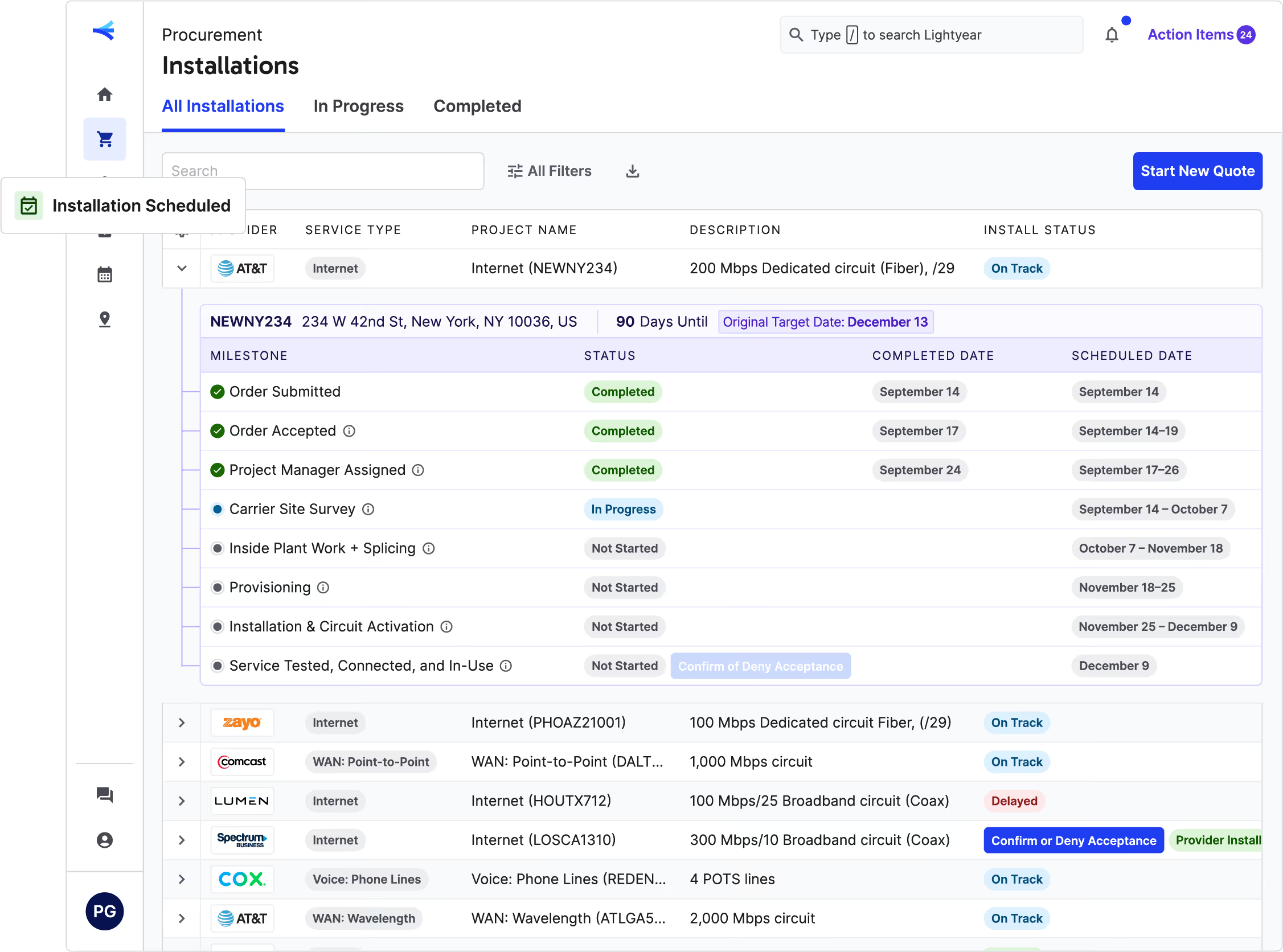
Installation timelines, escalations, and SLA adherence are rarely linked back to the original RFP, leaving teams without a clear view of whether the project delivered on expectations.
Why traditional telecom RFPs are broken
As you can see, the way most telecom RFPs are still run creates delays, inflates costs, and limits your vendor choices. The main problems usually fall into three buckets:
Outdated, manual workflows
Many teams still manage RFPs with spreadsheets, long email threads, and disconnected communications between IT, procurement, and finance. This slows progress, increases the chance of missed details, and makes collaboration unnecessarily difficult.
Limited visibility and skewed comparisons
Without access to current market data, companies often default to a short list of familiar vendors, overlooking potentially better options for telecommunication systems, data services, or management services.
Even when new providers are considered, opaque pricing structures make it hard to compare quotes. Hidden fees buried in contract language can make a seemingly competitive bid far more expensive over time.
Inefficient evaluation and excessive complexity
Overly complex, government-style templates can bog down the process with documentation that doesn’t add value. At the same time, evaluation criteria are often inconsistent: one team might focus on performance while another zeroes in on cost.
Without standardized scoring, decisions can default to the lowest price rather than the best long-term fit.
What telecom teams really need from the RFP process
A successful telecom RFP is about ensuring every step supports the business’s operational and financial goals. That means building the process around five core requirements:
1. Clear, specific technical requirements
The RFP should detail exact bandwidth needs, redundancy requirements, and service types — such as DIA, VoIP, broadband, or MPLS — so vendors can propose solutions that match the network’s intended use.
2. Accurate, market-based pricing benchmarks
Instead of relying solely on vendor quotes, teams need data that shows what comparable organizations are paying for similar services. This prevents overpaying and strengthens contract negotiations.
3. Verified provider coverage data
RFPs work best when they include proof of which providers have infrastructure at or near each site. This avoids wasting time on bids from vendors who can’t actually deliver service.
4. Standardized evaluation criteria
A scoring framework that weighs technical performance, cost, contract terms, and support capabilities ensures all proposals are measured on the same scale.
5. Implementation and lifecycle planning
The process should account for what happens after the contract is signed, including installation timelines, escalation procedures for delays, and ongoing service management.
When these elements are missing, organizations risk ending up with contracts that cost more than expected, underperform in service quality, or fail to meet long-term business needs.
Lightyear’s approach to telecom RFPs
There are a few telecom expense management software platforms on the market, but many simply digitize the same slow, vendor‑biased workflows and don’t offer full RFP automation.
Lightyear takes a different approach.
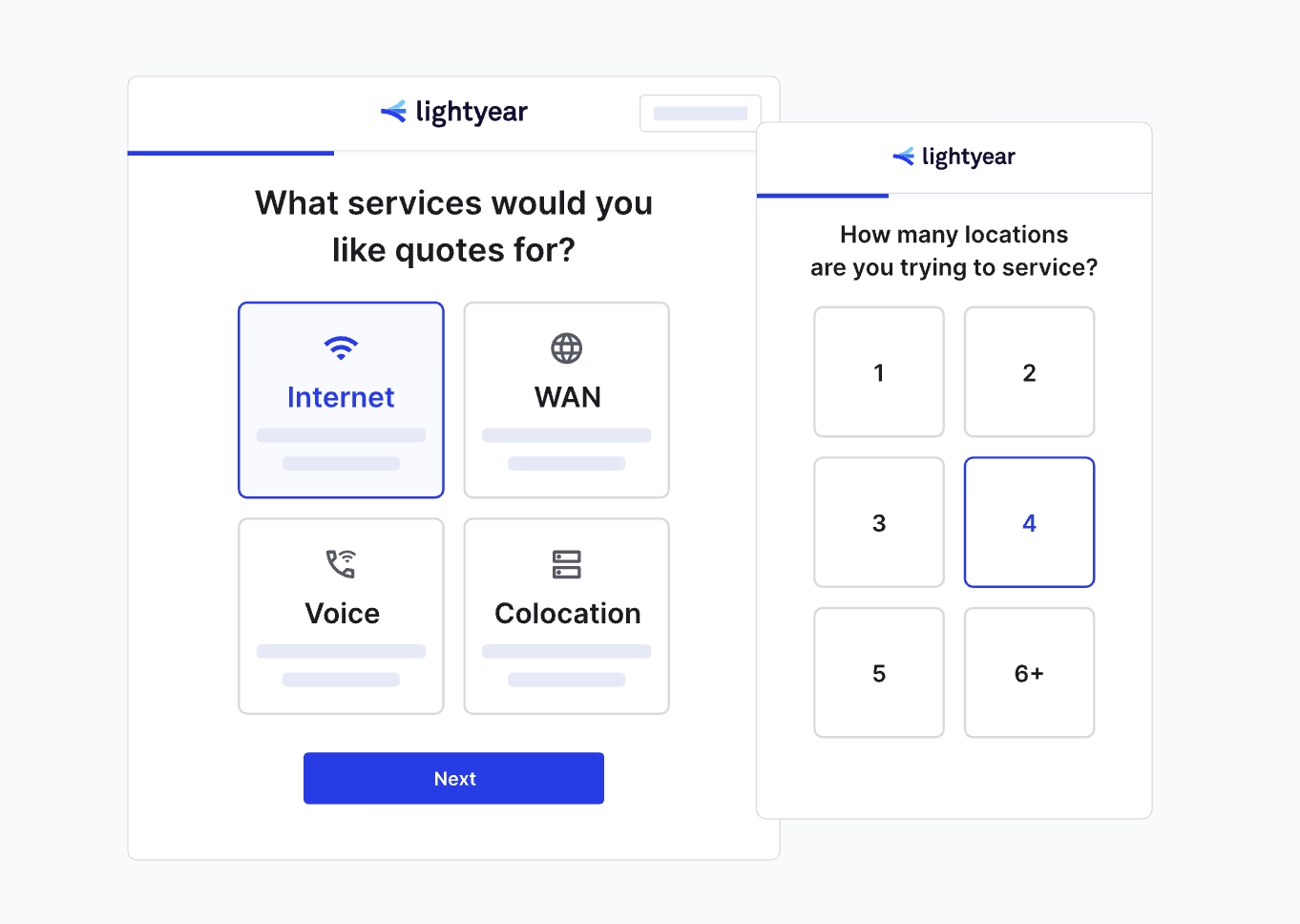
Our automated RFP process starts with an online RFP intake questionnaire, where you define bandwidth, service type, and redundancy requirements for one or hundreds of sites in just a few minutes. That gets your process started smartly and centrally, rather than buried in old Word docs or email threads
From there, our platform uses its proprietary network and pricing intelligence to find the most exhaustive set of vendors and prices. Lightyear’s software maps each address against our provider footprint data to optimize for on-net, Type-1 carriers (i.e., carriers that own the last-mile access at that site vs. Type-2 carriers, who resell another carrier’s access and are typically slower and pricier).
Quotes are checked against market benchmarks, responses come back in a uniform format for true apples-to-apples comparison, and—once you choose a provider—installation milestones, escalations, and asset details flow into Network Inventory Manager for ongoing lifecycle management.
How a Lightyear-powered RFP works
- Complete the intake – Fill the RFP questionnaire once for all sites (bandwidth, redundancy, service type).
- Review matched bids – We invite only on-net Type-1 carriers and benchmark every quote against live market data.
- Choose & track – Compare apples-to-apples proposals, sign, then track install milestones and SLAs in one place.
The result: faster quotes, cleaner comparisons, and lower unit costs, especially at multi-site scale.
Real cost savings from using Lightyear
When you replace manual, vendor-biased RFP workflows with Lightyear’s automated process, the payoff shows up fast — in shorter timelines, lower costs, and better vendor coverage.
Here’s what that looks like in practice:
70%+ faster procurement cycles
Lightyear’s automation consistently cuts procurement timelines by more than two-thirds. Okta, for example, reduced vendor management, invoice auditing, and procurement work by over 70% after replacing manual follow-ups with Lightyear’s platform.
Quotes in hours, not weeks
Standardized outreach and automated bidding mean teams like Elauwit can secure competitive rates for dozens of dedicated circuits in hours instead of weeks. That speed translates into wins on the revenue side as well.
Expanded vendor access and regional coverage
With integrations to more than 1,200 service providers, Lightyear surfaces regional carriers that many enterprises overlook. For Everon, this reach proved critical during a high-stakes corporate separation, maintaining emergency connectivity while simultaneously lowering costs.
Better pricing through market intelligence
Real-time benchmarks ensure you never overpay. Teladoc Health identified more than 20% savings by reshopping circuits before renewal and auditing invoices against Lightyear’s pricing dataset.
Centralized visibility for smarter spend
From RFPs to installation tracking to billing, Lightyear brings it all under one roof with Network Inventory Manager and Bill Consolidation.
This level of process optimization is critical in the telecommunications industry, where timelines and due dates can make or break a project.
For example, Everon is using Lightyear to consolidate vendor management and bulk purchase services across hundreds of sites—a move that preserves emergency connectivity, lowers costs, and ensures no savings opportunity is missed.
The outcome: shorter project timelines, sustained annual cost reductions, and fewer operational bottlenecks. With Lightyear handling procurement complexity, teams stay focused on engineering, innovation, and growth, not chasing down spreadsheets and vendor emails.
Ready to modernize your telecom RFP process with Lightyear?
If you're still using Word docs and email threads to run RFPs, it's time to try a better way. Lightyear automates the entire telecom RFP workflow, helping you save time, improve outcomes, and get enterprise-grade support at every step.
Try our questionnaire today to see how we can help you modernize telecom procurement.
Let us show you the product and discuss specifics on how it might be helpful.
Schedule a Demo





Revolutionize Your Telecom Experience
Learn how you can get one step closer to optimal business efficiency for all your telecom services.