11 UCaaS service providers reviewed: The 2026 buyer’s guide
Compare the top UCaaS providers in 2026, explore key trends, and see how software-powered procurement helps IT leaders pick the right solution.


Choosing the right UCaaS service provider in 2026 is harder than ever. The market is crowded with hundreds of vendors, most offering similar features, yet with wildly different pricing models, contract terms, and support quality. Add in the explosion of AI-powered features, hybrid work demands, and complex licensing structures, and it’s no wonder IT leaders struggle to make confident decisions.
This guide breaks down what UCaaS delivers, the trends shaping the market, how leading providers compare, and why a software-powered procurement approach is the smarter way to go.
What UCaaS delivers
Unified Communications as a Service (UCaaS) consolidates business communications into a single, cloud-based platform. Instead of juggling separate phone systems, video conferencing apps, and messaging tools, UCaaS brings them together with one interface accessible across devices.
Typical UCaaS solutions include:
- Voice and VoIP calling with advanced call routing, voicemail, and call recording
- Video conferencing and video meetings with screen sharing and collaboration tools
- Team messaging and instant messaging for real-time communication
- File sharing and collaboration tools to streamline workflows
- CRM integrations with platforms like Salesforce and Microsoft Dynamics
- Contact center functionality or integration with CCaaS for customer-facing teams
The benefits are clear:
- Scalability: Add or remove users in minutes without new hardware.
- Cost savings: Replace on-premises PBX systems with subscription-based cloud services.
- Simplified IT: Providers handle uptime, updates, and compliance.
- Support for remote work: Consistent access across desktops, mobile apps, and browsers.
For many enterprises, UCaaS is no longer optional. It’s the backbone of modern business communications.
2026 UCaaS market trends we’re noticing
Several shifts are shaping how enterprises evaluate UCaaS providers this year:
AI becomes standard
Providers now embed AI-powered features like real-time transcription, automated meeting summaries, sentiment analysis, and intelligent call routing. These tools reduce manual work and improve customer experience.
At the macro level, 78% of organizations use AI in at least one business function (up from 55% a year earlier), showing mainstream adoption beyond pilots.
Integration as a priority
UCaaS platforms increasingly serve as hubs for existing business systems. Native integrations with Microsoft Teams, Salesforce, and other enterprise apps streamline workflows, while APIs allow custom connections.
The average company now runs 100+ apps (global average 101), showing the need for tight UCaaS integrations and APIs.
Pricing pressure
Competition has driven down per-seat costs, but transparency remains inconsistent. Many providers still hide true costs behind add-ons or complex licensing.
Analysts flag “intense price pressures” in North American UCaaS, driving providers to differentiate with AI and packaging, not list price alone.
Hybrid work optimization
Mobile apps, device flexibility, and geo-redundant infrastructure are now table stakes. Providers are optimizing for distributed teams that need consistent uptime and seamless collaboration.
Hybrid is the steady state: harmonized estimates show ~25% of paid workdays in the U.S. are worked from home in 2025.
Top UCaaS providers in 2026
Here’s a fact-driven look at leading UCaaS providers, their strengths, and best-fit scenarios.
1 - Microsoft Teams
- Best for Microsoft-first organizations already using 365.
- Deep integration with Outlook, SharePoint, and Dynamics CRM.
- Options for direct routing, operator connect, or Microsoft Calling Plans.
- Pricing: Essentials from $4/user/month; Business Standard at $12.50/user/month.
- Watch out for: Complex licensing and add-on costs for advanced telephony.
2 - Zoom
- Best for video-first collaboration and scalability.
- Zoom Phone adds a cloud PBX with global coverage.
- AI Companion provides real-time transcription, summaries, and meeting insights.
- Pricing: Pro at $13.33/user/month; Business at $18.33/user/month.
- Watch out for: Advanced features often require add-ons.
3 - Cisco Webex
- Best for security-conscious enterprises.
- Strong compliance (HIPAA, FedRAMP, GDPR) and end-to-end encryption.
- Flexible PSTN options: Webex Calling, Cloud Connected PSTN, or Local Gateway.
- Pricing: Free tier available; paid plans from $144/year.
- Watch out for: Interface can feel heavier compared to Zoom or Teams.
4 - RingCentral
- Best for global enterprises needing advanced call management.
- Strong analytics, APIs, and CCaaS integration.
- AI-driven call routing and voicemail transcription.
- Pricing: Core at $30/user/month; Ultra at $45/user/month.
- Watch out for: Can be overkill for small businesses.
5 - Nextiva
- Best for user experience and customer-facing teams.
- Intuitive interface with call routing, voicemail-to-email transcription, and CRM integrations.
- Pricing: Digital at $20/user/month; Engage at $40/user/month.
- Watch out for: Lower-tier plans limit video conferencing duration.
6 - Vonage
- Best for VoIP-heavy organizations and global teams.
- Strong API platform for custom workflows.
- Features include call recording, SMS, and CRM integrations.
- Pricing: Mobile at $13.99/line/month; Advanced at $27.99/line/month.
- Watch out for: Costs add up with custom APIs and regional support differences.
7 - 8x8
- Best for enterprises needing UC + CC in one platform.
- XCaaS integrates UCaaS and CCaaS with AI-powered workflows.
- Supports up to 500 participants in video meetings.
- Pricing: Not always transparent; requires direct engagement.
- Watch out for: Interface and onboarding can feel dated.
8 - GoTo Connect
- Best for SMBs prioritizing security and support.
- HIPAA and GDPR compliance, 24/7 support, and strong VoIP features.
- Pricing: Phone System at $29/user/month; Contact Center at $86/user/month.
- Watch out for: Higher starting price compared to competitors.
9 - Sangoma
- Best for hybrid or on-premises flexibility.
- Owns its full stack (hardware + software), making troubleshooting easier.
- AI features include transcription, summaries, and call routing.
- Watch out for: Reporting tools less customizable than niche analytics platforms.
10 - Dialpad
- Best for AI-driven productivity.
- Real-time transcription, sentiment analysis, and coaching tools.
- Strong fit for startups and distributed teams.
- Watch out for: Enterprise voice routing options are still maturing.
11 - Intermedia
- Best for MSPs and resellers.
- White-label UCaaS with hosted Exchange, voice, and video.
- Reliable uptime and customer service.
- Watch out for: Limited advanced AI or automation features.
Possible challenges in picking a provider
Even with clear vendor strengths, enterprises face recurring challenges:
Pricing opacity
Many UCaaS providers advertise low entry-level costs, but those prices often don’t tell the full story. Advanced features like analytics, compliance tools, and integrations are usually locked behind add-ons or complex licensing. The result is that enterprises frequently discover the real total cost of ownership only after committing.
Overlapping functionality
Most UCaaS platforms now include a similar set of core features: voice, video, messaging, and basic integrations. This makes it hard to differentiate one provider from another, and IT teams can easily fall back on brand recognition rather than aligning the choice to actual business requirements.
Network dependencies
Even the most feature-rich UCaaS platform can underperform if the underlying internet connection isn’t reliable. Without SLA-backed dedicated connectivity, call quality may suffer from jitter, latency, or dropped sessions. Enterprises evaluating UCaaS need to look beyond the software and account for the network foundation supporting it.
Contract complexity
Hidden fees, auto-renewals, and long lock-ins are common in UCaaS contracts. These terms can limit flexibility and keep businesses tied to platforms that no longer meet their needs. Negotiating proof-of-concept periods or shorter agreements upfront is often critical to avoid these traps.
Vendor bias
Sales representatives are naturally incentivized to push their own platform rather than what’s best for the customer. This bias can leave IT leaders with a solution that doesn’t fit their technical or financial priorities. Neutral, data-driven procurement strategies can help cut through the noise and focus on true business alignment.
How to scope & procure UCaaS the right way
Evaluating UCaaS providers manually is time-consuming and often biased. That’s where Lightyear can help.
Here’s how our UCaaS procurement platform works:
- Automated vendor matching: We work with 300+ UCaaS providers and instantly filter down to those that fit your business needs.
- Data-driven pricing benchmarks: Our database of tens of thousands of quotes ensures you only see competitive per-seat pricing.
- Contract guardrails: We negotiate proof-of-concept periods and flexible terms to protect you from lock-in.
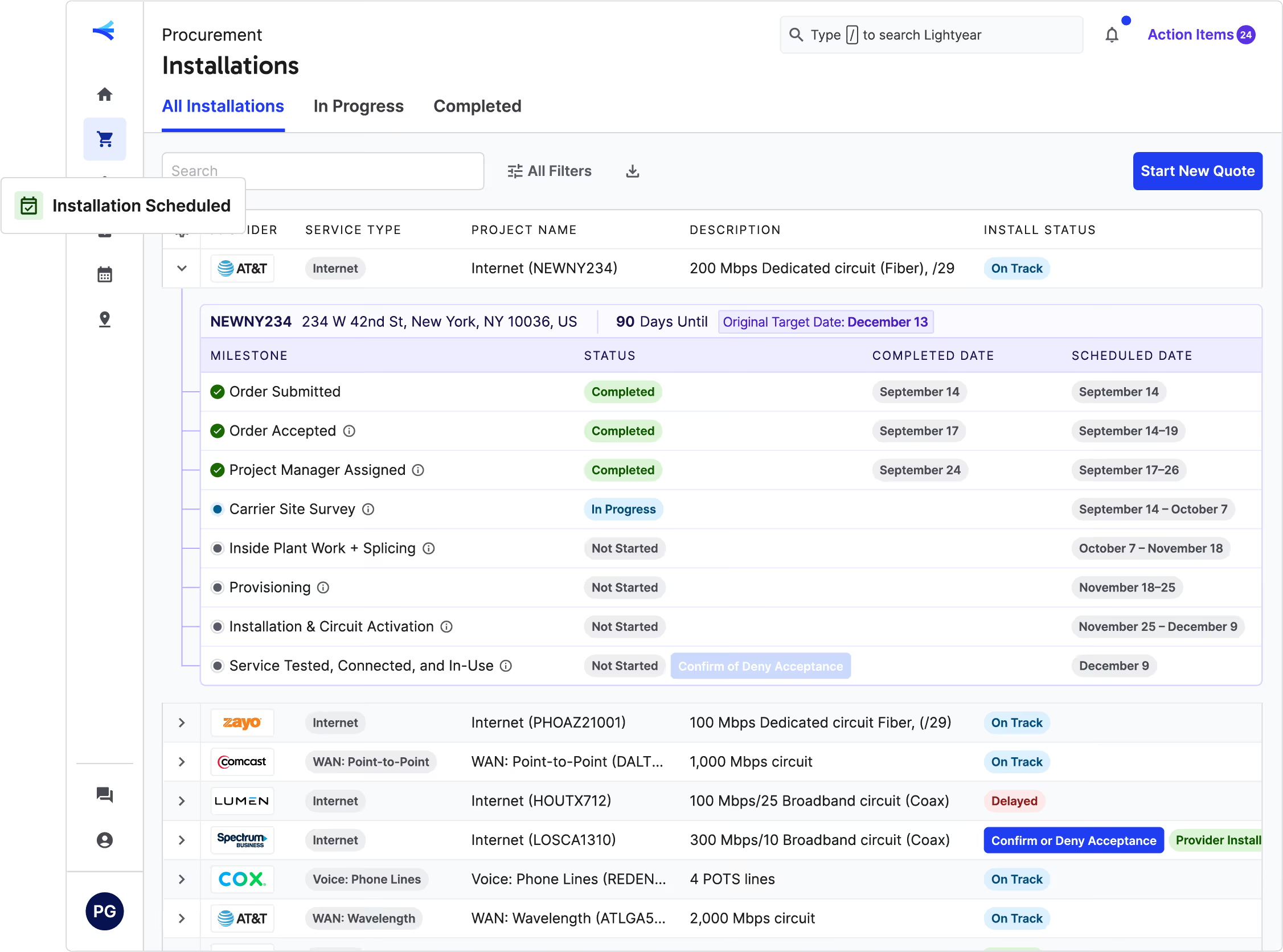
- Implementation support: Our Customer Success team manages the process from quote to install.
In short, Lightyear gives you the transparency and control missing from the UCaaS market. Instead of sitting through endless demos and sales pitches, you get a shortlist of best-fit providers backed by real pricing data.
Find the right UCaaS fit for your business with Lightyear
The best UCaaS provider for your business depends on your priorities, whether that’s AI-driven productivity, global scalability, security compliance, or ease of use.
With Lightyear, you can configure your UCaaS solution in seconds, compare providers side by side, and move forward with confidence.
Configure your UCaaS solution today and see how software-powered procurement makes finding the right provider faster, easier, and more cost-effective.
Let us show you the product and discuss specifics on how it might be helpful.
Schedule a Demo





Revolutionize Your Telecom Experience
Learn how you can get one step closer to optimal business efficiency for all your telecom services.